
Most people buying active honey for health reasons have heard of Manuka. Far fewer have heard of Jarrah. That's a marketing gap, not a quality gap — and this post exists to close it.
Both honeys carry independently verified antimicrobial activity. Both are produced in the Southern Hemisphere from native flora. Both are sold at a premium on the basis of that activity. But they're measured by different rating systems, sourced from fundamentally different botanical origins, and supported by different bodies of evidence. If you're buying honey because you want the verified antibacterial properties — not just the label — understanding the difference matters.
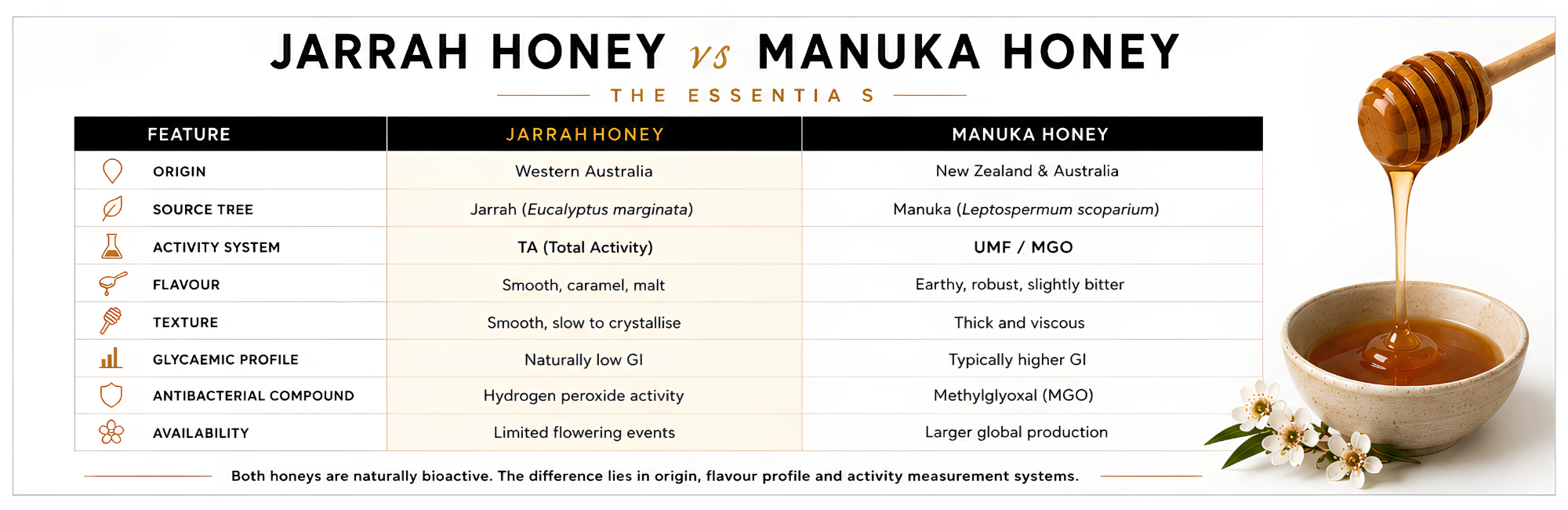
What is Manuka honey?
Manuka honey is produced from the nectar of Leptospermum scoparium, a flowering shrub native to New Zealand and parts of south-eastern Australia. It has been the subject of significant scientific research since the 1980s, when Professor Peter Molan at the University of Waikato first identified its unusually stable antibacterial activity.
The key compound responsible for Manuka's activity is methylglyoxal (MGO), which forms naturally in the nectar of Leptospermum flowers. Unlike the hydrogen peroxide-based activity found in most honeys — which degrades with heat, light, and dilution — MGO is stable under those conditions. This stability is what makes Manuka's activity clinically meaningful and commercially significant.
Manuka is graded using two main rating systems: MGO (milligrams of methylglyoxal per kilogram of honey) and UMF (Unique Manuka Factor), a trademark-controlled grading system administered by the UMF Honey Association of New Zealand. Both systems measure the same underlying compound through different expressions. MGO 100+ is considered entry-level active; MGO 400+ and above is considered high-potency therapeutic grade.
New Zealand Manuka has global brand recognition, regulatory frameworks, and decades of consumer marketing behind it. It is also, as of recent years, affected by the varroa mite — a parasitic mite that has spread through New Zealand's bee population and creates ongoing challenges for colony health and honey quality consistency.
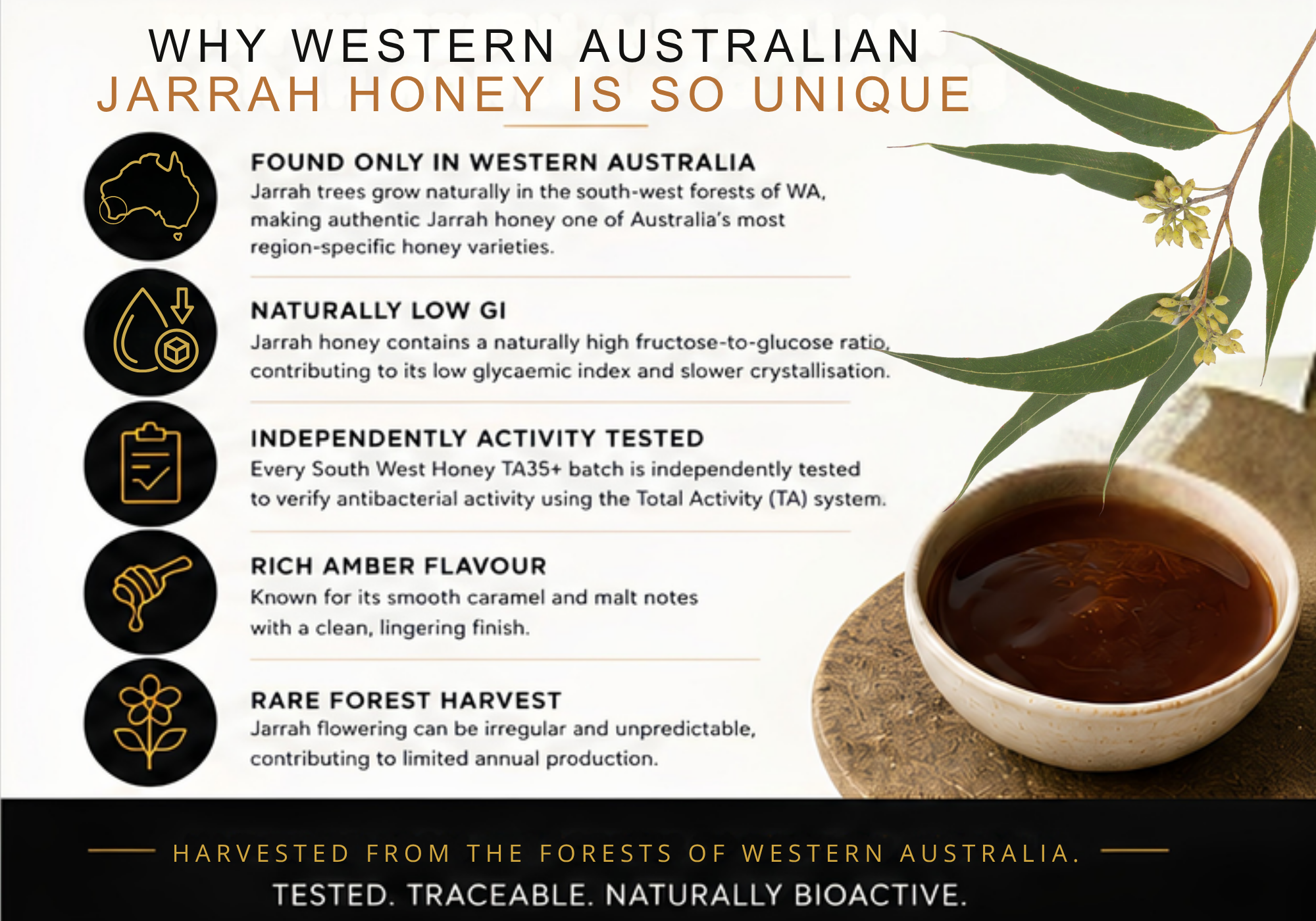
What is Jarrah honey?
Jarrah honey is produced from the nectar of Eucalyptus marginata — the Jarrah tree — a hardwood eucalyptus endemic to the southwest of Western Australia. The Jarrah forest is one of the most biodiverse woodland ecosystems on earth, covering an arc of land from north of Perth down through the ranges to Pemberton and Manjimup.
Jarrah trees are notoriously irregular bloomers. They flower heavily every two years at best, and in some years produce little or no nectar at all. This irregularity is not a weakness — it's the reason Jarrah honey is genuinely rare. A beekeeper whose hives sit in Jarrah forest cannot guarantee a harvest. The trees decide.
The antibacterial activity in Jarrah honey operates through a different mechanism to Manuka. The primary active compound is hydrogen peroxide, generated enzymatically from glucose oxidase — an enzyme naturally present in honey that activates on dilution. Jarrah's activity is high-grade, independently verified, and measured against the Total Activity (TA) scale: a percentage phenol equivalence assay conducted against Staphylococcus aureus ATCC 9144 using the University of Waikato agar well diffusion method — the same methodology that underpins Manuka research.
Our Jarrah honey is sourced exclusively from hives placed in the forests surrounding Pemberton, Western Australia — a region with no agriculture, no chemical spray, and no industrial land use within foraging range. It is cold-extracted below 40°C to preserve the enzymatic activity that heat processing would destroy.
Western Australia is also, critically, one of the last significant honey-producing regions on earth to remain free of the varroa mite. As of 2026, varroa has not established in WA. This has meaningful implications for colony health, honey purity, and the long-term consistency of supply — none of which are guaranteed in varroa-affected regions.
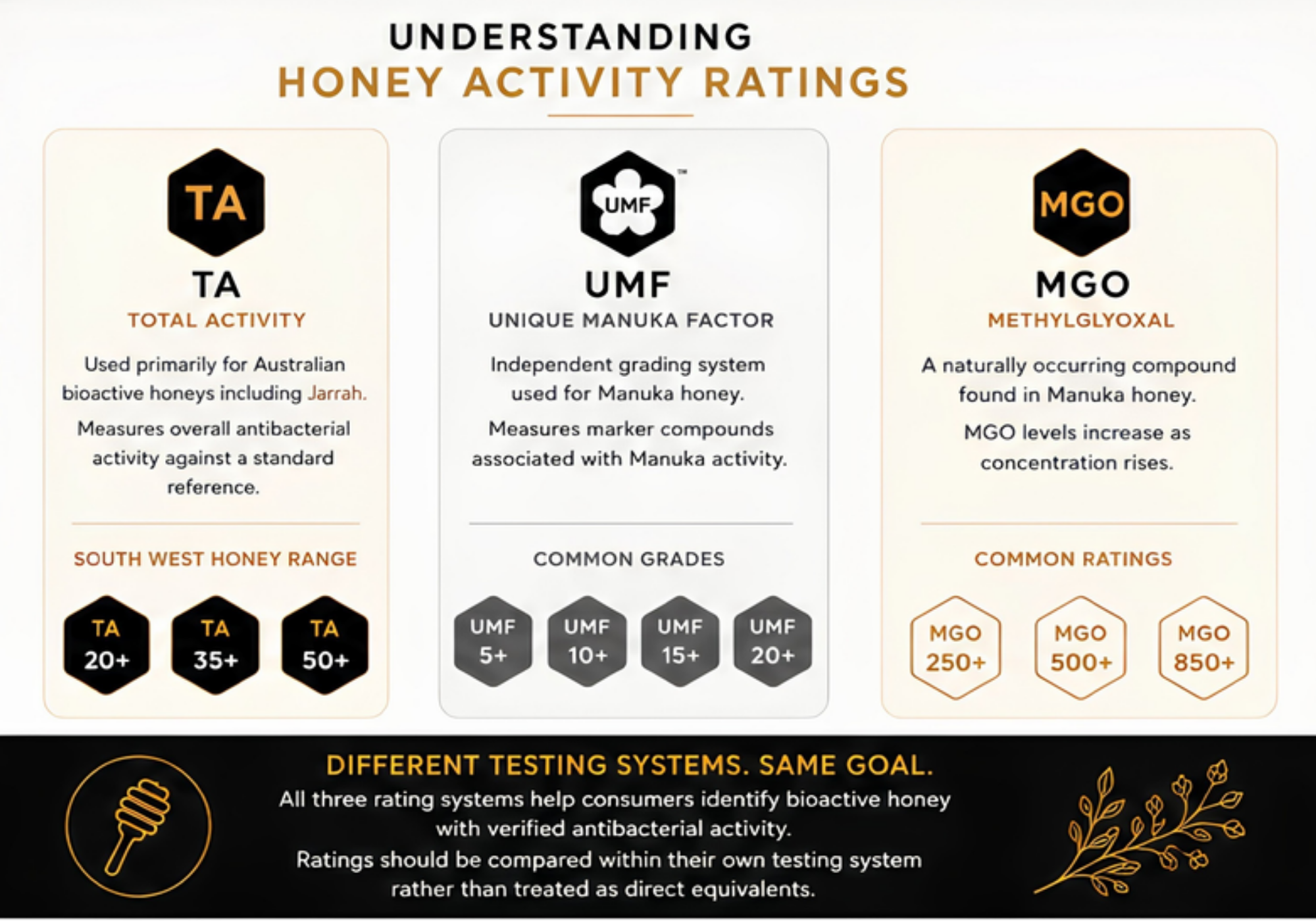
How are TA and MGO ratings measured — and how do they compare?
This is where most comparisons between Jarrah and Manuka break down, because the two rating systems are measuring different things through different methods.
MGO measures a specific chemical compound — methylglyoxal — in milligrams per kilogram of honey. It is a direct chemical assay. A high MGO result means a high concentration of that specific molecule.
TA (Total Activity) measures the total antimicrobial effect of a honey sample against a bacterial control — expressed as the percentage of phenol solution that would produce an equivalent zone of inhibition. It is a bioassay: it measures what the honey actually does to bacteria, not just what compounds are present. This distinction matters. A TA result reflects the combined antibacterial action of all compounds present in the honey, including hydrogen peroxide, phenolics, and other bioactive constituents.
The testing method used for our Jarrah honey is the University of Waikato agar well diffusion assay — the same foundational methodology used in Manuka research. Our certificates of analysis are issued by accredited laboratories: Analytica Laboratories (Hamilton, New Zealand) and ALS Food & Environmental NZ, both operating from the Ruakura Research Centre.
Our most recent certificates show the following actual measured results for Jarrah batches:
June 2024 (Lab ref 24-16652, Analytica Laboratories): 35.1% phenol equivalence. Disclosed on label as TA35+.
March 2026 (Lab ref 26-03503, ALS Food & Environmental NZ): two separate Jarrah batches measured at 39.3 and 35.0+ respectively. Both disclosed as TA35+.
We disclose the actual measured result rather than the label rating on request — and we report the label rating conservatively below the measured result. This is a deliberate policy. It means the TA number on the jar is a floor, not a ceiling.
How does TA compare to UMF and MGO?
A direct equivalence is not scientifically precise — the assays measure different mechanisms — but a working approximation used in the industry is:
TA10+ ≈ UMF 5+ / MGO 83+
TA20+ ≈ UMF 8–10+ / MGO 263–400+
TA35+ ≈ UMF 10–15+ / MGO 400–514+
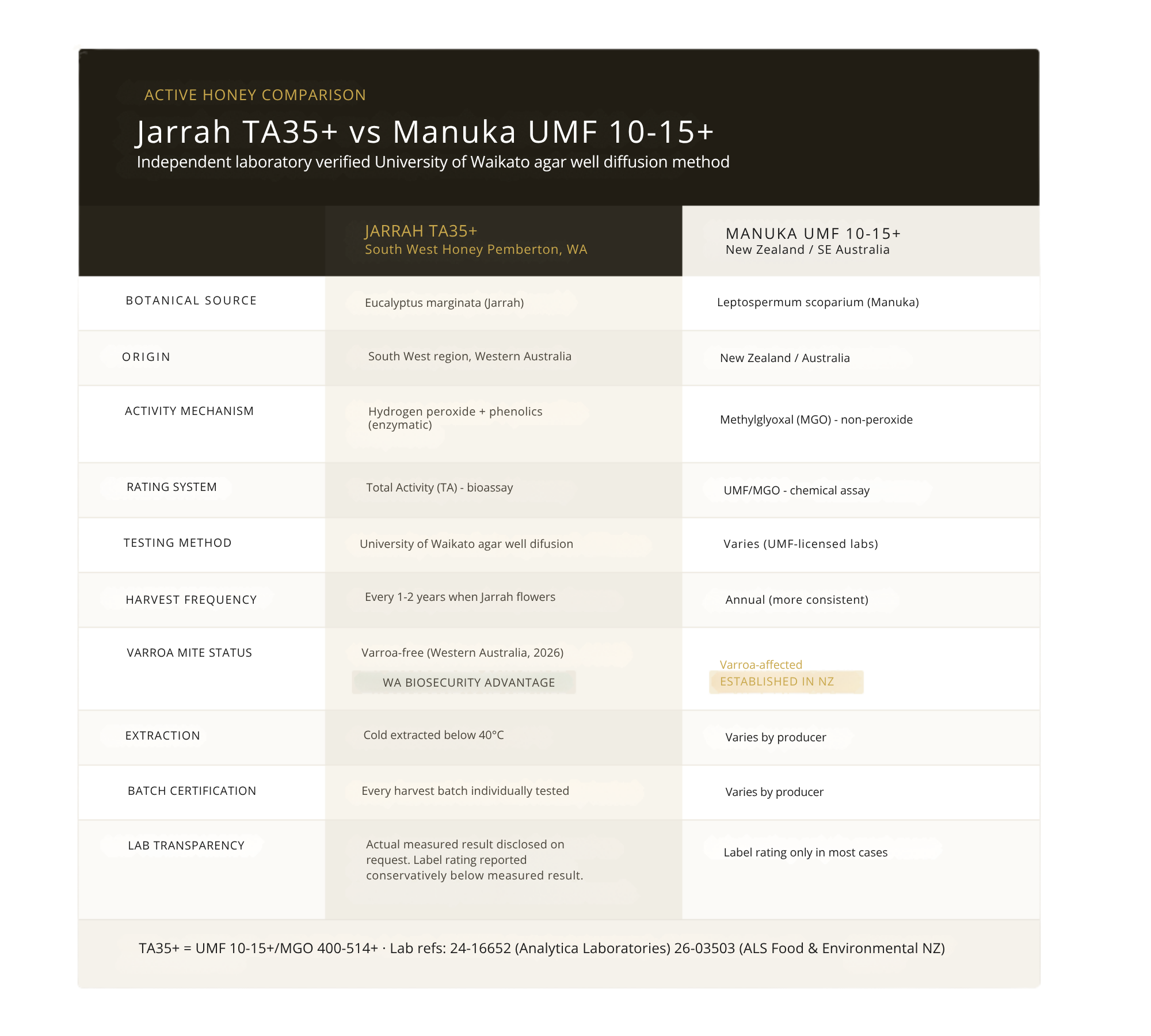
On this basis, our Jarrah TA35+ sits in the same activity range as Manuka rated UMF 10–15+ — the range most commonly recommended for therapeutic use.
Side by side: Jarrah TA35+ vs Manuka UMF 10–15+
A note on activity stability
One substantive difference between Jarrah and Manuka worth understanding: Jarrah's hydrogen peroxide activity is partially inhibited in its undiluted state by naturally occurring catalase in the honey. It activates more fully on dilution — which is relevant for wound care and topical use, less so for direct consumption.
Manuka's MGO activity, being non-peroxide, is stable in both diluted and undiluted forms and is not affected by heat to the same degree.
This does not make one honey superior to the other for all applications. It means they behave differently, and that understanding the mechanism is more useful than comparing label ratings in isolation.
For direct consumption — a daily teaspoon for immune support, gut health maintenance, or general wellbeing — both honeys deliver bioactive compounds at TA35+ / UMF 10–15+ rating. The difference in mechanism is more relevant for clinical or wound-care applications where delivery method matters.
Which should you choose?
If you want the most recognised name in active honey, Manuka is it. The research base is extensive, the regulatory framework is established, and the consumer awareness is global.
If you want a verified, single-origin, cold-extracted active honey from a region whose forests have stood for centuries, whose bee populations remain varroa-free, and whose producer tests every harvest batch individually and discloses the actual measured result — Jarrah is the answer. It is not a lesser alternative to Manuka. It is a different honey, from a different tree, with a different story and a comparable verified activity level.
The two honeys share the most important thing: independently measured antibacterial activity backed by laboratory evidence. What South West Honey offers beyond that is transparency about exactly where the honey came from, exactly what was measured, and exactly who measured it.
About our testing
Every harvest batch of South West Honey Jarrah TA35+ is tested individually by an accredited New Zealand laboratory using the University of Waikato agar well diffusion assay against Staphylococcus aureus ATCC 9144. Results are expressed as percentage phenol equivalence and reported on a Certificate of Analysis issued by the testing laboratory.
We do not pool batches to average results. We do not label a jar with a TA rating it has not individually achieved. Certificates of analysis are available on request for any batch currently in stock.