
Does Honey Expire?
Short answer: no. Raw honey does not spoil.
Stored sealed in a cool, dark place, honey stays safe to eat indefinitely. What it will do is crystallise, darken slowly, and gradually lose some of its activity — none of which is spoilage. If there's a best before date on your jar, that date is about quality, not safety.
Here's what's actually happening inside the jar.
Why honey doesn't spoil
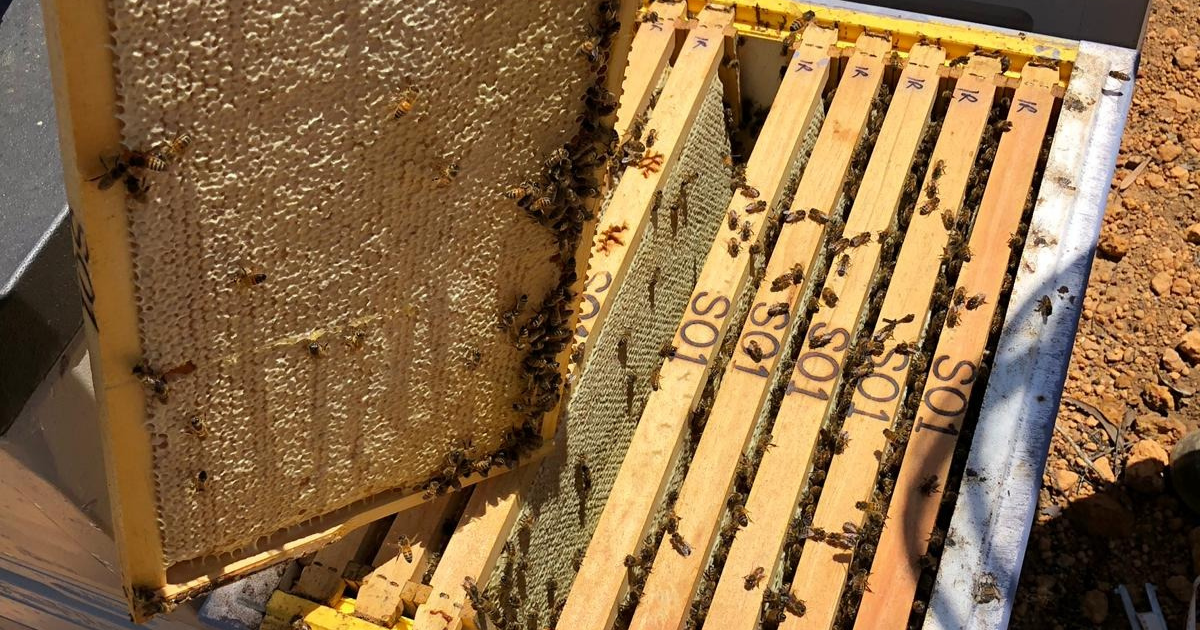
Honey is one of the very few foods that will not go off on its own, and no preservative is ever added to it. The bees handle that themselves, in four ways.
It's mostly sugar, and almost no water. Ripe honey is roughly 80% sugar and sits under 18% water. Bees take nectar that started near 70% water and fan it down to that point before capping the cell.
There's nothing left for bacteria to drink. All that sugar binds the remaining water so tightly that very little of it is free. Water activity sits near 0.6 — below what most bacteria and moulds need to grow. Put a microbe in honey and osmosis draws the water straight back out of it.
It's more acidic than you'd expect. Honey typically falls between pH 3.5 and 4.5, closer to tomato juice than to anything you'd call sweet. Gluconic acid does most of that work, and it's produced inside the hive.
The bees add an enzyme. Bees secrete glucose oxidase into the nectar as they work it. When honey meets moisture, that enzyme converts glucose into gluconic acid and hydrogen peroxide, released slowly rather than all at once.
Between them, those four things make honey a genuinely hostile place for anything to live.
So why does my jar have a best before date?
Because of how Australian food labelling works — not because the honey is about to turn.
Under Standard 1.2.5 of the Food Standards Code, a best before date isn't required at all for food with a shelf life of two years or more. Many honey producers print one anyway, either because their packaging runs are shared with other products, because a retailer's system demands a date field, or simply because customers expect to see one.
A best before date is a quality marker. It's the producer's estimate of how long the honey will be at its best. It is not a use by date, and honey is not a food that carries one.
What actually changes over time
Three things, none of which make honey unsafe.
It crystallises. This is the big one, and it's the reason most jars get thrown out unnecessarily. Crystallisation is glucose coming out of solution and forming crystals. It's a sign the honey is raw and unprocessed, not a sign it's gone off. Some varietals crystallise within weeks; others stay liquid for a year or more. Stand the jar in a bowl of warm — not hot — water and it will return to liquid.
It darkens. Slowly, through a natural browning reaction. The flavour deepens with it. Plenty of people prefer honey this way.
It loses activity. This one matters if you bought your honey for its rating, and it's the part most producers don't talk about.
What the Western Australian research shows
In 2023, researchers at the University of Western Australia published a study in the Journal of Applied Microbiology looking specifically at how storage affects Jarrah and Marri honey — our honeys, not Manuka.
They tested storage from −80°C up to 45°C, over periods from 16 weeks to five years. The findings were clear:
Heat is the enemy, not time. At 45°C, hydrogen peroxide had dropped to negligible levels within eight weeks. Jarrah and Marri honeys stored between 37°C and 45°C showed significant losses of antibacterial activity after twelve weeks.
Cool storage held activity steady. Honeys kept at 4°C and below stayed relatively stable throughout.
Five years at room temperature gave mixed results. Some honeys lost activity over that period. Others actually gained it. Age alone was not the deciding factor — temperature was.
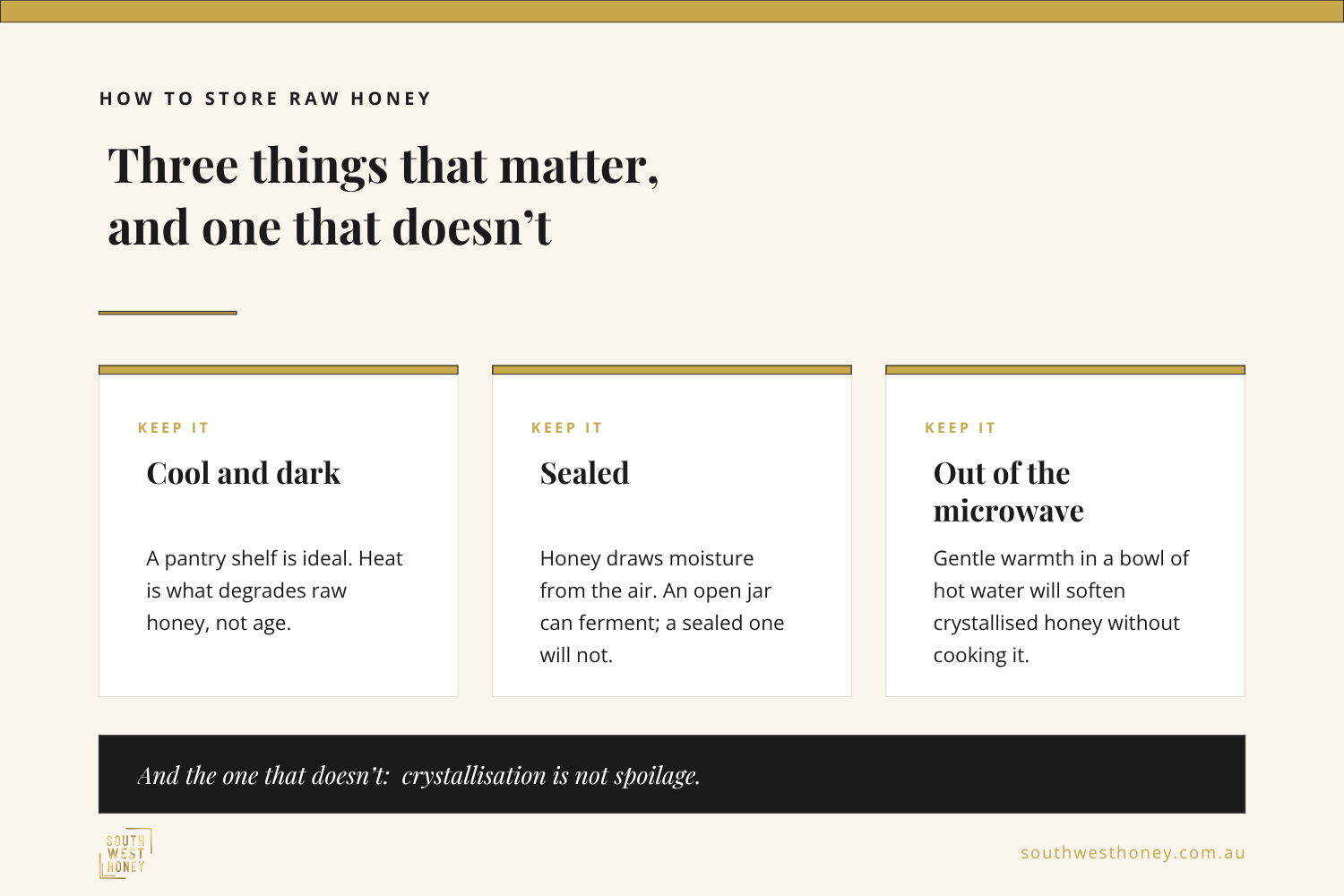
The practical takeaway is simple. A jar kept in a cool pantry will hold its character for years. A jar left in a hot car boot over a Perth summer, or sitting on a shelf above the stove, is a different story.
What this means if you bought honey for its TA rating
A Total Activity rating is a laboratory measurement taken at a point in time — the result for that batch, when it was tested. Because a meaningful share of that activity in Jarrah, Redgum and Blackbutt is peroxide-based, and because peroxide activity is heat-sensitive, how the honey is treated after testing matters.
That's why we don't heat our honey, and it's why we'd rather tell you how to store it than let a good jar quietly lose what you paid for.
If you'd like the detail on how the rating systems compare, we've written that up separately: What Is TA Honey? TA vs UMF vs MGO Explained.
When honey genuinely is a problem
Three situations, for completeness.
If it smells fermented or fizzes. Honey with a water content above roughly 20% can ferment, and an open jar left in a humid kitchen can pick up enough moisture to get there. Sour smell, bubbling, or an alcoholic note means it's fermenting. That's a storage failure, not an expiry.
If there's visible mould. This is rare, and it means something was introduced into the jar — usually a wet or dirty spoon.
Never give honey to a baby under twelve months. Honey can contain dormant bacterial spores that an adult digestive system handles without difficulty but an infant's cannot. This applies to all honey, raw or pasteurised, from any producer. Australian health authorities are unambiguous on it.
The short version
Honey doesn't expire. It crystallises, it darkens, and if it's kept hot it loses activity. Keep it sealed, keep it cool, keep it out of the microwave, and a jar will be good years after the date printed on it.
That's not a marketing line. It's what three thousand years of archaeology and a fair bit of chemistry both say.
We're a family-owned apiary in Western Australia. Our honey is raw, unheated, and comes from our own hives. Every batch is independently laboratory tested, and the rating on the jar is the result for that batch.