
What Is Jarrah Honey? A Complete Guide from a WA Producer
Most people discover Jarrah honey the same way. Someone mentions it in passing — a friend, a naturopath, a label in a health food store — and the question follows: what actually is it, and why does it cost that much?
This guide answers that question properly. We're a Western Australian honey producer who harvests Jarrah every season the forest allows. Everything here comes from what we've observed, tested, and learned across more than a decade of working inside WA's ancient forest systems.
No marketing language. Just what Jarrah honey actually is, how it works, and how to get the most out of it.

What Is Jarrah Honey?
Jarrah honey is a monofloral honey produced from the nectar of the Jarrah tree (Eucalyptus marginata), a species of eucalyptus found almost exclusively in the ancient forests of south-west Western Australia. It is harvested by honeybees foraging the Jarrah canopy during the tree's brief flowering season and is distinguished by its deep amber colour, smooth caramel flavour, and exceptionally high antimicrobial activity.
Because the Jarrah tree grows only in WA's south-west — in ancient ironstone soils found nowhere else on earth — genuine Jarrah honey cannot be produced anywhere else in the world.
Where Does Jarrah Honey Come From?
The Jarrah tree (Eucalyptus marginata) grows in a narrow band of south-west Western Australia, from north of Perth down through the forests of the Darling Range and into the tall timber country around Pemberton and Manjimup. It prefers ancient, iron-rich lateritic soils that drain poorly in winter and become intensely dry in summer — conditions that stress the trees into producing dense, concentrated nectar.
These forests sit within the South West Australia Biodiversity Hotspot, one of only 36 such regions recognised globally. Over 75% of the plant species here are found nowhere else on earth. When our bees forage the Jarrah canopy, they are drawing nectar from an ecosystem that is genuinely irreplaceable.
The trees themselves are extraordinary. Jarrah grows slowly — taking up to 120 years to reach maturity — and can live for more than 1,000 years. The trees producing this season's honey were ancient before European settlement of Australia.
How Often Does Jarrah Flower?
Jarrah trees do not flower on a fixed annual schedule. Their full floral cycle takes two to four years to complete, and significant synchronised flowering events — when most trees in a forest region bloom together — are rarer still.
Flowering depends entirely on environmental conditions. Sufficient winter rainfall, spring warmth, and the right seasonal timing must align. In years where conditions don't cooperate, flowering may be sparse or fail to produce a harvestable nectar flow at all. When the season does arrive, it is brief — typically from October to December — and then the wait begins again.
This is why genuine Jarrah honey is limited in supply and cannot be produced at scale. It follows nature's calendar, not a commercial one.
What Makes Jarrah Honey Different from Regular Honey?
Most supermarket honey is a blended product — honeys from multiple origins, sometimes multiple countries, combined for consistency and price. It is typically heat-treated and ultra-filtered to extend shelf life and improve appearance. The result is a product with little traceability and significantly reduced natural enzyme activity.
Jarrah honey from a reputable WA producer is the opposite of that in almost every measurable way:
Single origin. Every jar comes from one tree species, in one region, harvested in one season.
Independently lab-tested. The antimicrobial rating on the label is assigned by an accredited laboratory, not by the producer.
Cold-extracted and minimally filtered. No heat treatment. Enzymes and natural compounds are preserved.
Batch-traceable. The batch number on the jar connects to a specific test result that can be verified.
Naturally low GI. Jarrah's high fructose-to-glucose ratio gives it a glycaemic index in the low 40s to low 50s — significantly lower than most honeys, including Manuka.
What Is the TA Rating on Jarrah Honey?
TA stands for Total Activity. It is the measurement used to assess the overall antimicrobial strength of WA monofloral honeys, and it is determined by independent laboratory testing — specifically the Well Diffusion Phenol Equivalent (WDPE) method.
In this test, a diluted honey sample is placed in agar hosting a common bacterium such as Staphylococcus aureus. The width of the inhibitory zone — the area where bacterial growth is suppressed — is measured and compared against a standard phenol solution. A honey rated TA20+ demonstrates antimicrobial activity equivalent to 20% phenol. A TA35+ honey is equivalent to 35% phenol.
TA captures the full spectrum of a honey's antimicrobial activity — both its hydrogen peroxide (peroxide) activity and any non-peroxide contributions — rather than measuring a single compound. This makes it a comprehensive measure of bioactive strength.
Common TA ratings and what they mean:
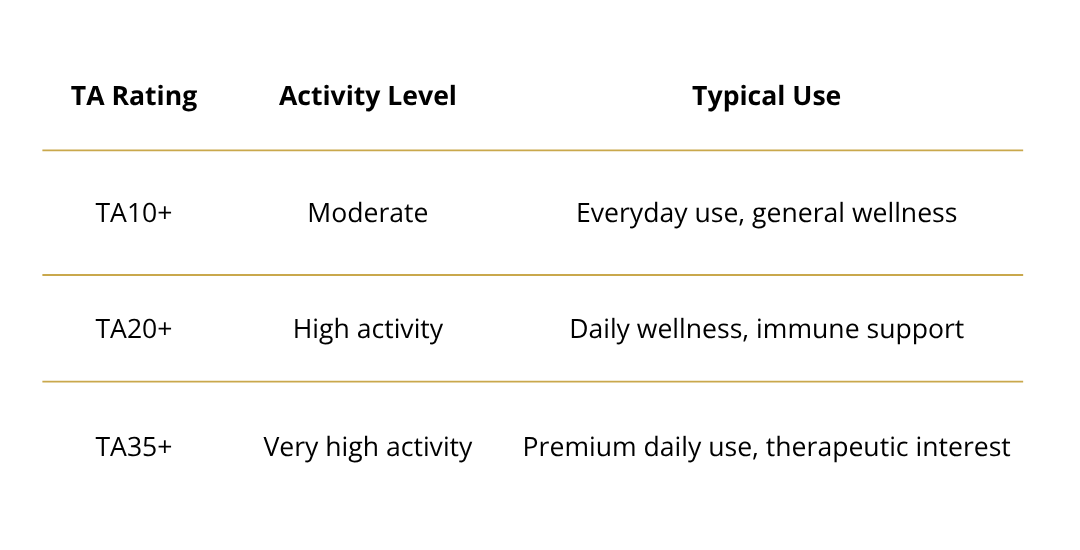
We recommend TA35+ for anyone seeking the strongest antimicrobial and antioxidant activity. For everyday use and flavour, TA20+ is an excellent choice at a more accessible price point.
Jarrah Honey vs Manuka Honey: What's the Difference?
This is the question we get asked most often, and it deserves a careful answer rather than a promotional one.
Origin: Manuka honey comes from the Manuka bush (Leptospermum scoparium), native to New Zealand and parts of eastern Australia., also grown as crops here in Western Australia. Jarrah honey comes exclusively from the Jarrah tree in WA's south-west forests. Neither tree grows in the other's region.
How they're rated: Manuka uses the MGO (methylglyoxal) or UMF rating system, which measures a single antibacterial compound — methylglyoxal. This is Manuka's primary source of non-peroxide antimicrobial activity.
Jarrah uses the TA (Total Activity) system, which measures the full spectrum of antimicrobial action — including the hydrogen peroxide produced by the glucose oxidase enzyme, as well as any non-peroxide contributions. The two rating systems are not directly comparable, because they measure different things.
Antimicrobial activity: Both honeys have genuine, scientifically validated antimicrobial properties. Research from ChemCentre WA and independent studies has found that high-TA Jarrah honey demonstrates strong antibacterial and antifungal activity. Studies have also found that Jarrah honey typically contains two to three times more antioxidants than equivalent Manuka honey — a significant nutritional distinction for people consuming honey for systemic wellness rather than wound care.
Flavour: Manuka has a strong, earthy, slightly medicinal taste that many people find intense. Jarrah is smooth, dark amber, and deeply caramel — most people find it far easier to eat daily. This makes Jarrah more naturally suited to incorporating into food and drink routines.
Glycaemic index: Jarrah honey's high fructose-to-glucose ratio gives it a notably lower GI than Manuka and most other honeys. It also means Jarrah honey does not crystallise easily and maintains its smooth, pourable consistency for years when stored correctly.
Practical choice: For topical, targeted wound care applications, Manuka has an extensive research base and remains the gold standard. For daily dietary wellness — immune support, antioxidant intake, gut health, a daily teaspoon — Jarrah's flavour profile, lower GI, higher antioxidant content, and broad-spectrum activity make it, for many people, the better choice.
What Are the Benefits of Jarrah Honey?
Jarrah honey has been the subject of independent research across Australian universities and government laboratories including ChemCentre WA. The findings consistently support several properties that health-conscious consumers value:
Antimicrobial activity. Jarrah's hydrogen peroxide-based antimicrobial mechanism is broad-spectrum — effective against a range of bacteria and fungi. The enzyme glucose oxidase, which bees introduce during honey-making, reacts with the honey's natural glucose and water to produce hydrogen peroxide at low, sustained levels when the honey is diluted.
High antioxidant content. Research has found Jarrah honey to be exceptionally rich in phenolic antioxidants — compounds that help the body manage oxidative stress and support immune function. Studies suggest Jarrah contains two to three times more antioxidants than comparable Manuka honey.
Low glycaemic index. Jarrah's GI of approximately 45–52 makes it one of the lowest-GI honeys available. For people watching blood sugar — including those with diabetes, who should still consume it in moderation — it is a better alternative to standard honey or refined sugar.
Gut health support. Research has explored Jarrah honey's prebiotic potential, with one study finding a probiotic index comparable to commercial prebiotic products. Its natural enzyme content, preserved through cold extraction, contributes to its role as a functional food.
Sore throat and immune support. Jarrah has been used by Western Australians for generations as a home remedy for sore throats, minor infections, and seasonal immune support. The antimicrobial mechanism is active when the honey contacts mucous membranes — making a teaspoon stirred into warm (not boiling) water a genuinely functional preparation.
Important note: Honey is a food product, not a medicine. The statements above reflect independent research findings and traditional use. They are not intended as medical advice. Do not give honey to children under 12 months.
Does Heat Destroy Jarrah Honey's Benefits?
This is perhaps the most important practical question — and the one most honey brands avoid giving a straight answer to.
Yes. Jarrah's primary antimicrobial mechanism comes from the enzyme glucose oxidase. This enzyme is heat-sensitive and begins to degrade at temperatures above approximately 45°C. At temperatures above 55°C, significant enzyme degradation occurs. Boiling water (95–100°C) destroys it substantially.
What this means in practice:
A cup of tea brewed with boiling water and stirred immediately is too hot. Wait 8–10 minutes until the liquid has cooled to a comfortable temperature, then add the honey.
Spreading on toast at room temperature, adding to cold smoothies, taking straight from the spoon, or stirring into room-temperature yoghurt — all preserve the enzyme fully.
Using Jarrah honey in baking or cooking above 55°C means you are choosing it for flavour, sweetness, and low GI properties. Those hold up to heat well. The antimicrobial enzyme does not.
The antioxidants, low GI properties, and natural minerals in Jarrah honey are heat-stable. Heat affects the enzyme activity specifically — not the honey's entire nutritional profile.
How Do I Know My Jarrah Honey Is Genuine?
This is a question worth asking seriously — particularly given well-documented fraud in the premium honey category globally.
When purchasing Jarrah honey, look for:
An independent Certificate of Analysis (CoA). The TA rating should be assigned by an accredited laboratory — not claimed by the producer without verification. Ask for it, or look for it on the producer's website.
A batch number on the label. This indicates the honey is traceable to a specific harvest and test result.
B-QUAL certification or equivalent. This is the Australian honey industry's audited food safety and traceability program. It verifies the production chain from hive to jar.
DPIRD-registered beekeeper. All commercial WA beekeepers are legally required to register with the Department of Primary Industries and Regional Development. Registration means the hives are traceable and the producer operates within Australia's biosecurity framework.
A producer who publishes their test results. Transparency is the clearest signal of confidence in the product. If a brand won't share its lab results, there's a reason.
At South West Honey, every batch is independently tested by an accredited laboratory before it is jarred. The Certificate of Analysis is available on request. The batch number on every jar connects to a specific test result.
How Should I Take Jarrah Honey?
There is no single correct answer, but here are the approaches most of our customers find work best:
Daily teaspoon (most common). One teaspoon straight from the jar, first thing in the morning before food. This is the most direct way to receive the full antimicrobial benefit — no heat, no dilution, no interference. Our Jarrah is smooth and mild enough to enjoy this way without difficulty.
In warm (not boiling) drinks. Let tea or warm lemon water cool to the point where you can comfortably hold the cup — roughly 45°C or below — then stir in your honey. This preserves the enzyme while still giving you a warm, soothing drink.
On food at room temperature. Drizzled over natural yoghurt, ricotta, aged cheese, fresh fruit, or sourdough at room temperature. This is also where Jarrah's flavour profile shines most clearly — the caramel and malt notes are more nuanced without heat.
In cold preparations. Smoothies, overnight oats, iced drinks, salad dressings. Cold temperatures have no effect on the enzyme and preserve everything in the jar.
One tablespoon per day is a reasonable daily intake for adults seeking consistent antimicrobial and antioxidant benefits. More is not necessarily better — quality of honey matters more than quantity.
Why Is WA Jarrah Honey Particularly Significant Right Now?
Western Australia remains entirely free from the Varroa destructor mite — the parasite that has now established itself permanently across New South Wales, Queensland, Victoria, South Australia, and the ACT.
Managing Varroa requires ongoing treatment with synthetic miticides. WA beekeepers have never needed these treatments, because there is no Varroa here to control. Our bees forage in forests that are not only pristine in terms of agricultural chemical exposure — they have never required Varroa treatment at all.
The practical result: WA Jarrah honey in 2026 comes from some of the healthiest bee colonies working some of the last untreated, ancient, disease-free forest systems in the world. That is not a marketing phrase. It is the current state of Australian beekeeping.
Australia's domestic honey production currently falls short of domestic consumption — the gap is filled by imported honey, some of which has been found to fail purity testing. The case for buying from a registered, audited, independently tested WA producer has never been stronger.
A Note on Where We Fit
South West Honey is a family-run WA producer. We harvest Jarrah, Marri (Redgum), Blackbutt, and seasonal coastal wildflower honey from ancient forests in WA's south-west. Every batch is independently tested before it reaches a jar. We are B-QUAL certified, DPIRD-registered, and we pay the national honey levy that funds the biosecurity infrastructure keeping WA Varroa-free.
We make our Certificate of Analysis available on request. If you'd like to see the lab results behind your jar before you buy, ask us. That's how it should work.
Our current range includes Jarrah, Redgum, Blackbutt, Coastal honey, bee pollen, raw honeycomb, and a honey flight tasting pack if you'd like to compare varieties side by side.
South West Honey is a registered WA honey producer and food business based in Western Australia. All honey is independently laboratory tested before release. Certificates of Analysis available on request.
Last updated: July 2026
Related reading:
How to read a honey label — what the Country of Origin bar chart actually means
The TA rating explained — how Jarrah honey is tested and what the numbers mean
Jarrah honey and heat — the full science on what temperature does to your honey