
Honey is one of the most adulterated foods in the world — and Australia is not immune. Independent laboratory research has found that close to one in five honey samples sold in Australia show signs of adulteration with cheap sugar syrups: corn syrup, rice syrup, cane sugar, and similar additives blended into the honey to bulk out the volume while keeping the label unchanged.
If that number surprises you, you're not alone. Most people assume "honey" means honey. The reality is that the word on a label and the contents of the jar are not always the same thing — and unless you know what to look for, there's often no way to tell the difference by sight or taste alone.
This post explains how honey fraud actually works, why it's so hard to detect, what the research shows about Australian honey specifically, and what genuine raw honey looks like when it's done properly.
How honey fraud actually works
There are two main forms of honey fraud, and they're often confused with each other.
Sugar syrup adulteration is the most common form. Cheap sugar syrups — corn syrup, rice syrup, cane syrup, beet syrup — are blended into genuine honey, or used to replace it almost entirely. The resulting product still looks like honey, pours like honey, and tastes sweet. But a significant portion of what's in the jar didn't come from a bee.
This isn't always a deliberate act by the seller. Sometimes it happens further up the supply chain — bees fed sugar syrup during periods when natural nectar is scarce can produce honey that contains traces of that syrup, which then enters the supply chain as "honey" without anyone along the way necessarily intending to deceive. Other times, it's a straightforward commercial decision: bulk out the product, increase the volume, sell it as pure.
Mislabelling is the second form. This is when genuine honey is sold with a false geographic origin or with quality claims that aren't backed by any testing. Honey produced in one country gets relabelled as coming from another. Ordinary honey gets marketed as "raw," "active," or "medicinal grade" with nothing to substantiate the claim. The honey itself might be real — but what's on the label isn't.
Both forms matter for the same reason: you're paying for something the product isn't.
What the research actually shows
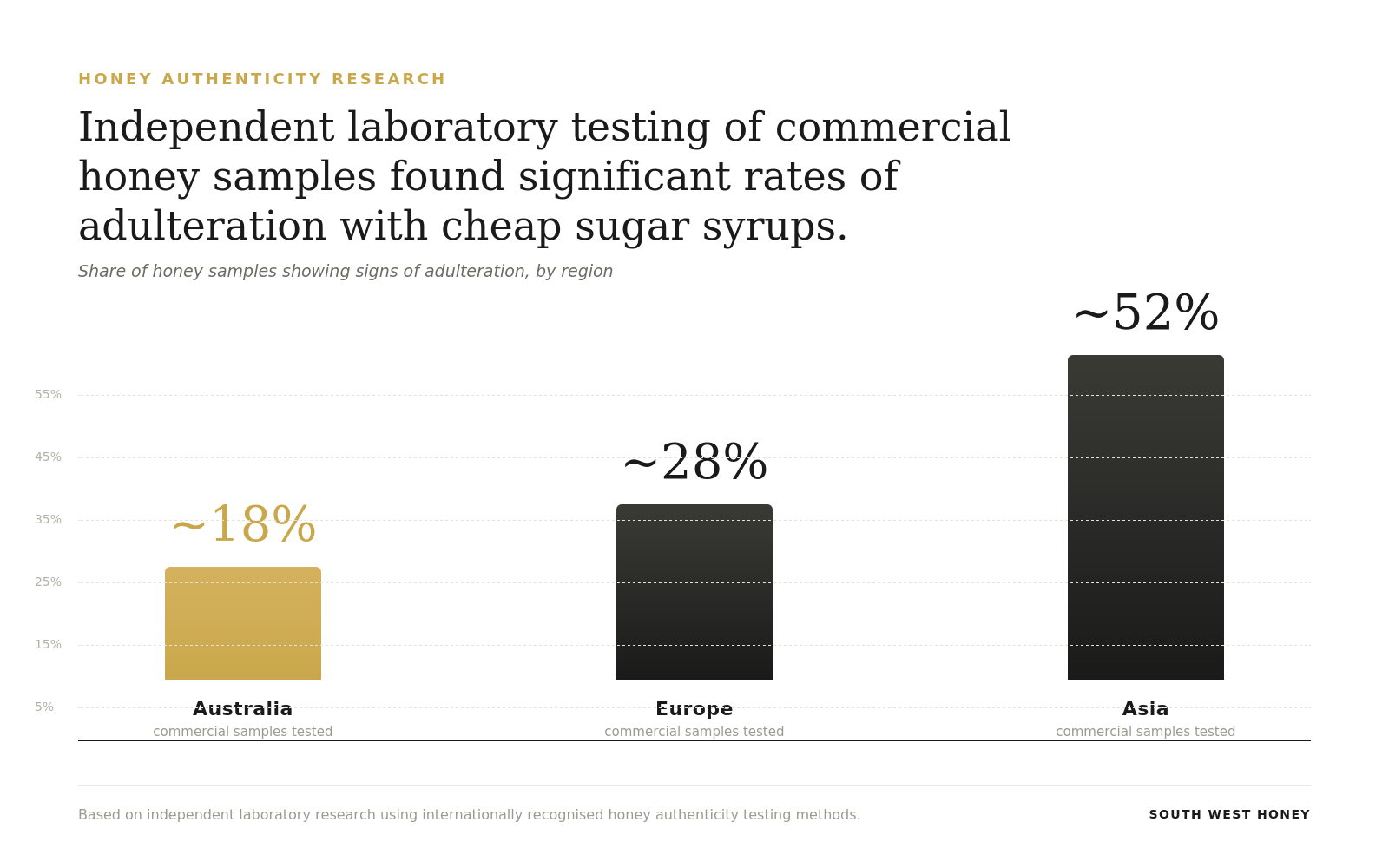
Independent laboratory research using internationally recognised testing methods has examined honey samples from Australia alongside honey from dozens of other countries. The findings: roughly one in five Australian honey samples showed signs of adulteration with cheap sugar syrups.
That sounds bad — and it is. But there's useful context. The same research found that Australian honey performed considerably better than honey from many other regions: roughly 28% of European honey samples and over half of Asian honey samples tested showed signs of adulteration. Australia isn't the worst-performing market in the world. But "better than Europe and Asia" is a low bar, and one in five is still a meaningful number — particularly when you consider that the honey aisle in most supermarkets doesn't tell you which jar is which.
One detail from this body of research is worth sitting with: when researchers tested premium Manuka honey specifically — honey that commands a significant price premium specifically because of its claimed potency — every single sample tested failed the standard authenticity test for sugar source. Premium positioning and premium pricing are not, on their own, evidence of anything. They're just positioning and pricing.
Why this is so hard to catch — even for retailers
Here's the part that surprises most people: a retailer selling adulterated honey often has no idea. Honey changes hands multiple times between hive and shelf — beekeeper, packer, blender, distributor, retailer — and at most of those steps, nobody is testing.
Australia imports thousands of tonnes of honey every year, much of it for blending, repackaging, and re-export. Under current import inspection arrangements, only a small fraction of incoming honey shipments are tested at the border. Honey that has been blended from multiple source countries becomes very difficult to trace back to its origin — which is exactly the point, from a fraud perspective. By the time it's on a supermarket shelf in a jar that says "Australian Honey," tracing what's actually inside back to a specific hive in a specific place is, in most cases, simply not possible.
This is also why taste and appearance aren't reliable indicators. A well-made syrup blend can look right, pour right, and taste sweet enough that most people wouldn't notice anything wrong. The methods that actually detect adulteration — pollen marker analysis, sugar profiling, isotope testing — require a laboratory. They are not things you can do by holding a jar up to the light.
Five things to check before you buy
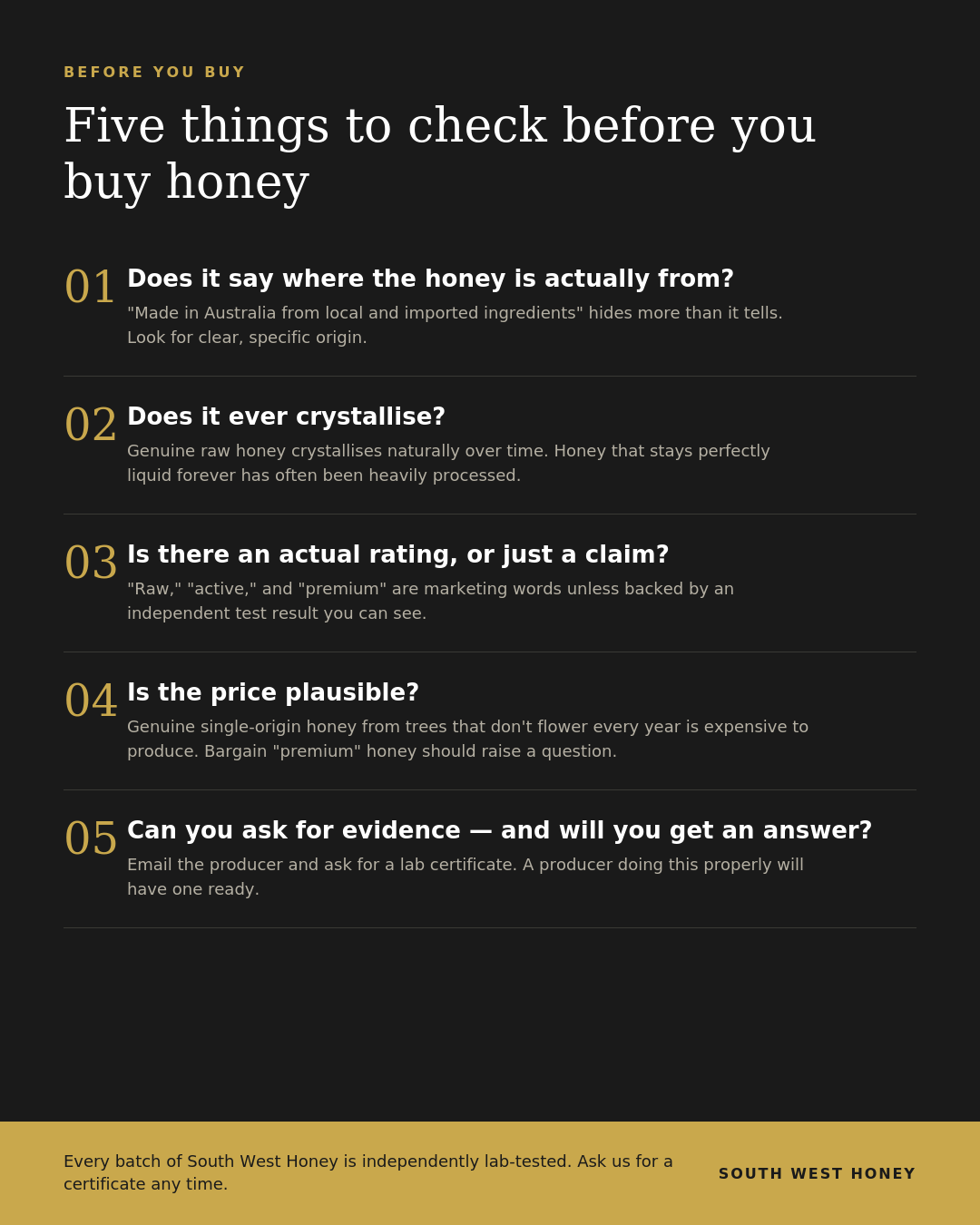
You can't run a lab test in the supermarket aisle, but there are signals worth paying attention to.
How we test our honey
Every harvest batch of South West Honey is sent to an accredited laboratory and tested individually using the University of Waikato agar well diffusion method — the same foundational methodology used in Manuka honey research internationally. This produces a Total Activity (TA) result: a measured figure, not a marketing claim.
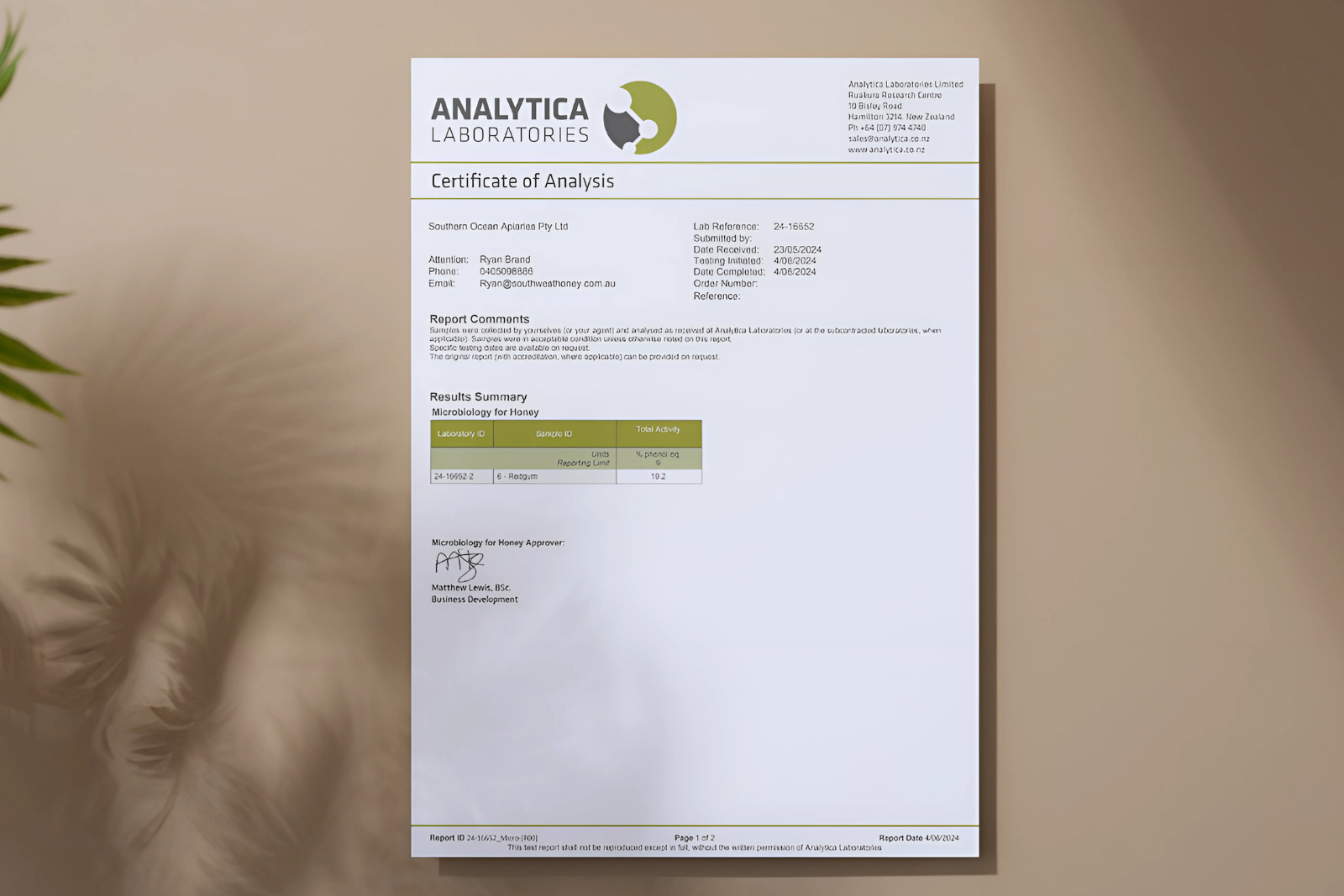
We also test for C4 sugar adulteration — the screening method that detects exactly the kind of cane and corn syrup contamination described above — and for pesticide residues. Every batch, every time. Not because anyone is required to ask for it, but because "independently certified" should mean something you can actually see.
The TA rating printed on our jars is always reported conservatively below the laboratory's actual measured result. If our Jarrah TA35+ tests above 35%, the label still says TA35+. We'd rather under-promise on the label and over-deliver in the jar than the other way around.
If you'd like to see the certificate of analysis for a current batch, email us at sales@southwesthoney.com.au and we'll send it through. No account, no signup — just the document.
The honey that doesn't need to hide anything
The honey fraud conversation can feel discouraging — like there's no way to know what you're actually buying. But the flip side of "most honey isn't tested" is that tested honey stands out. A producer who tests every batch, discloses the actual result, and will email you a laboratory certificate on request isn't doing anything complicated. They're just doing the thing that the one-in-five statistic shows most of the market isn't.
If you're buying honey for its flavour, its provenance, or its measured activity — ask the questions above. The honey that's real won't mind.
Shop our independently certified Jarrah,Blackbutt, and Redgum TA35+ honey →