
How to substitute honey for sugar in baking
To replace sugar with honey in baking, use about three-quarters of a cup of honey for every cup of sugar, take out about 60 ml of the other liquid, add a pinch of bicarb soda and lower the oven by about 15°C. Honey browns faster than sugar, so check your bake early.
That is the whole method in one paragraph. The rest of this guide explains why each step matters, gives the conversions in Australian cups, spoons and grams, and covers which recipes suit honey and which are better left alone.
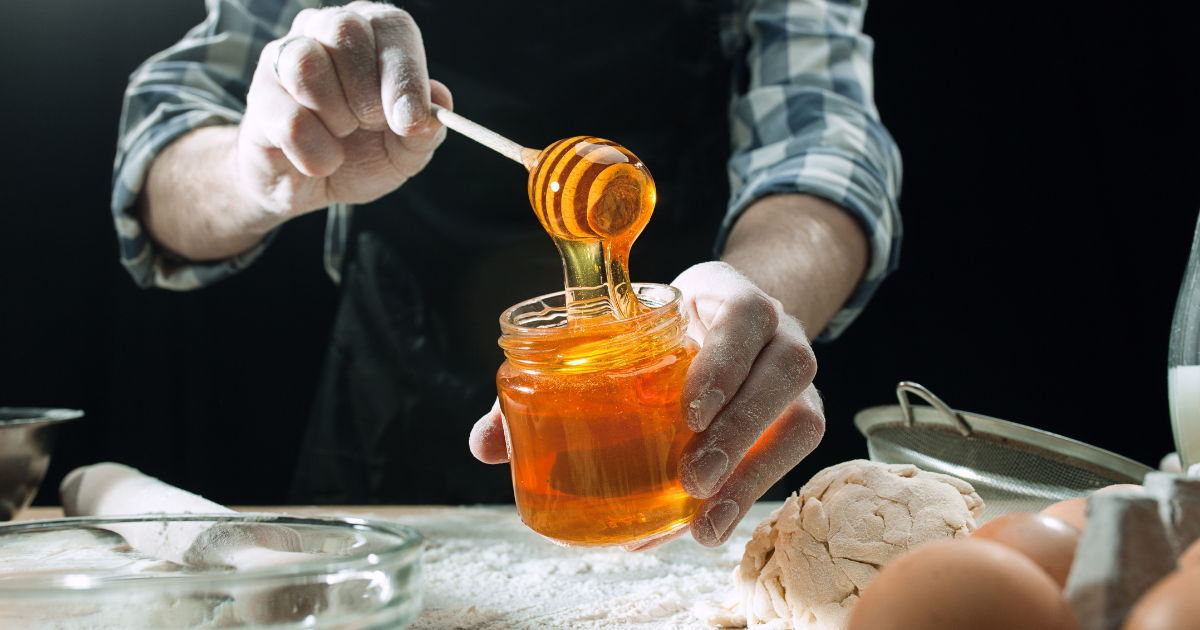
The four rules
Use less honey than sugar. Honey is sweeter, so about three-quarters of a cup of honey does the work of one cup of sugar. If you like things less sweet, two-thirds of a cup is enough.
Take out some liquid. Honey is a little under one fifth water. For every cup of sugar you replace, remove about 60 ml of milk, water or juice from the recipe. If the recipe has no liquid to remove, add 3 tablespoons of flour instead.
Add a little bicarb soda. Honey is slightly acidic. A pinch of bicarb, up to a quarter of a teaspoon for each cup of honey, balances it and helps the bake rise. Yeast breads do not need it.
Turn the oven down. Honey browns and burns sooner than sugar. Lower the temperature by about 15°C, keep it at or under 180°C, and start checking a few minutes early. If the top is colouring too fast, cover it loosely with foil.
Honey to sugar conversions in Australian measures
These use the Australian metric cup of 250 ml and the Australian tablespoon of 20 ml. Weighing is easier and less sticky than measuring by cup, so grams are included.
1 cup sugar (220 g): use ¾ cup honey (about 265 g) and remove 60 ml of liquid
¾ cup sugar (165 g): use ½ cup plus 1 tablespoon honey (about 200 g) and remove 45 ml of liquid
½ cup sugar (110 g): use ⅓ cup plus 2 teaspoons honey (about 135 g) and remove 30 ml of liquid
⅓ cup sugar (75 g): use ¼ cup honey (about 90 g) and remove 20 ml of liquid
¼ cup sugar (55 g): use 2 tablespoons plus 1 teaspoon honey (about 65 g) and remove 15 ml of liquid
A few weights worth knowing: one Australian tablespoon of honey is about 28 g, one teaspoon is about 7 g, and one cup is about 355 g.
If you are following an American recipe, their tablespoon is 15 ml and their cup is 240 ml. For most bakes the difference is small enough to ignore in cups and worth noticing in tablespoons.
What honey changes in a bake
Honey does more than sweeten.
It keeps things moist. Cakes and loaves made with honey are softer and stay that way for longer.
It adds colour. Expect a deeper golden crust.
It adds flavour. A mild honey gives a gentle warmth. A dark, strong honey will be the main thing you taste.
It makes a denser crumb. Sugar creamed with butter traps air, and honey cannot do that in the same way.
Where honey works well
Muffins, banana bread and loaf cakes
Muesli bars, slices and granola
Soft, chewy biscuits
Bread and buns, where a spoonful also helps the crust colour
Glazes, marinades and salad dressings, where no other changes are needed
Where to keep the sugar
Meringue and pavlova, which need dry sugar to hold their shape
Crisp biscuits and shortbread, which will turn soft
Light sponges that rely on sugar beaten with eggs or butter
Toffee, caramel and other sweets where the sugar has to set hard
If you are unsure about a favourite cake, replace half the sugar the first time and see how it turns out.
Which honey to bake with
Use a mild, everyday honey. Heat flattens the finer flavours of a single-flower honey and reduces the activity of a rated one, so a premium jar is wasted in the oven. Save that for eating as it is.
Our Western Australian Coastal Honey is the one we would bake with. It is mild, it comes in a 400 g jar, and it costs the least per 100 g in our range. Our guide to how to choose honey explains the differences.
Three tips for measuring honey
Weigh it if you can. Sit the bowl on the scales and pour straight in.
If you are using a cup or spoon, rinse it in hot water or wipe it with a little oil first. The honey will slide out cleanly.
If your honey has crystallised, stand the jar in warm water until it runs again. Crystallised honey is perfectly good for baking. We explain why honey sets in does honey expire?
Common questions about baking with honey
How much honey replaces one cup of sugar?
About three-quarters of a cup, or 265 g. Remove about 60 ml of other liquid from the recipe at the same time.
Can I replace all the sugar with honey?
In muffins, loaves, slices and most soft bakes, yes. In cakes that rely on creaming butter and sugar, replace half first. In meringue, pavlova and crisp biscuits, keep the sugar.
Can I use honey in place of brown sugar?
Yes, with the same rule. The flavour will be a little different, because brown sugar tastes of molasses and honey tastes of flowers.
Do I need to change the oven temperature?
Yes. Lower it by about 15°C and check early. Honey colours quickly, and a bake can look done on top before the middle is cooked.
Why did my honey cake turn out dense?
Usually because the extra liquid was left in, or all the sugar was replaced in a recipe that needed it for lightness. Take out the liquid, add the pinch of bicarb, and try replacing half next time.
Is honey better for you than sugar?
Honey is still a sugar and is best treated like one. The reasons to bake with it are flavour and texture.
Can babies eat food baked with honey?
No. Honey should not be given to children under 12 months old, and that includes honey in baking.
Where to start
Pick a forgiving recipe for your first try. Banana bread and muffins are hard to get wrong. Our honey recipes have a few to begin with.
For the honey, a jar of Western Australian Coastal Honey is all you need. Delivery is a flat $9.95 anywhere in Australia, and free on orders over $125.